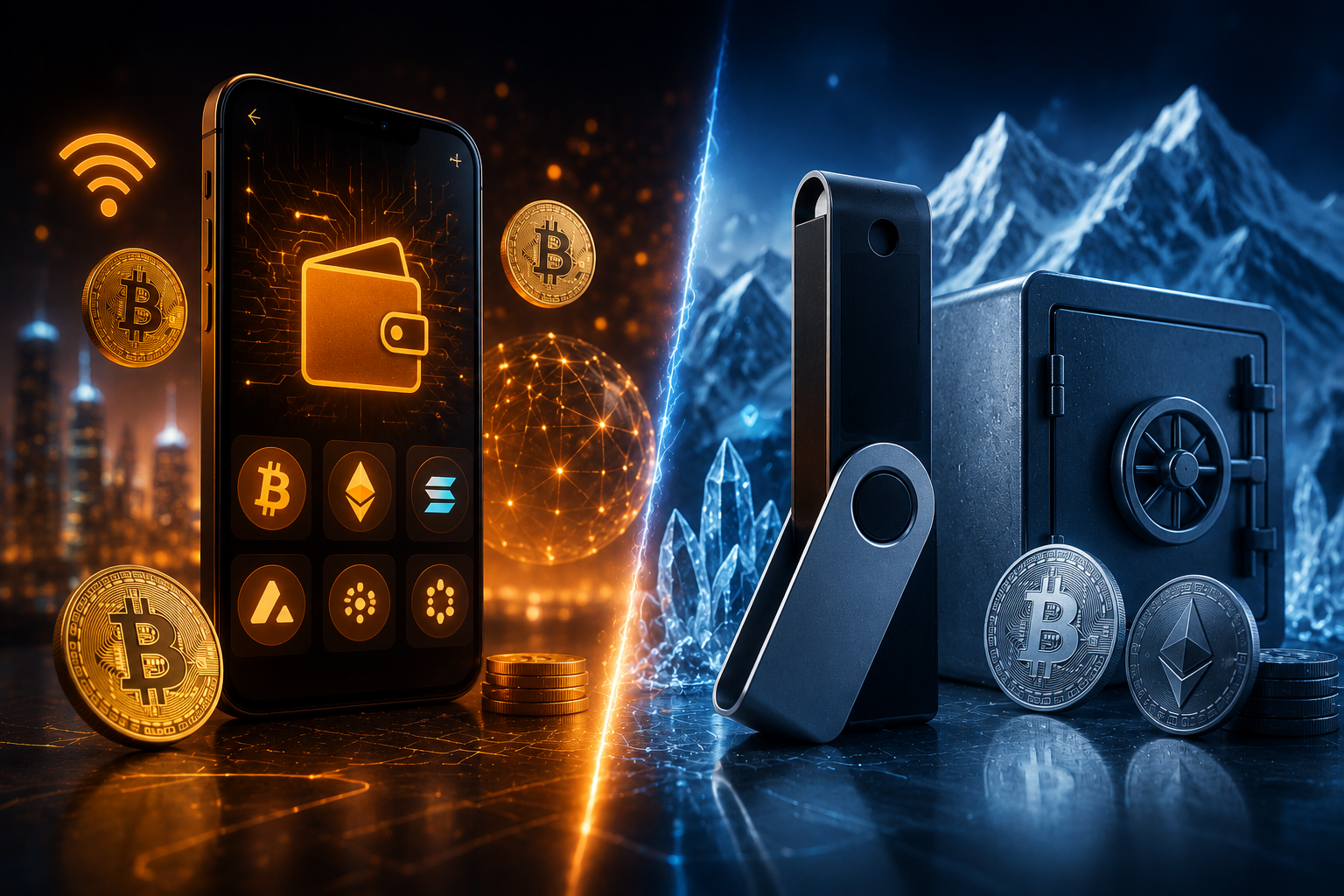

So you’ve bought some crypto. Congrats. But now there’s a question nobody really warned you about. Where do you actually keep it? It’s not like cash you can stuff under a mattress. And leaving it sitting on an exchange feels… a little risky. You’ve probably heard scary stories.
This is where crypto wallets come in. And the big choice everyone faces is hot wallet vs cold wallet. They sound like temperature settings, but they’re actually about how your crypto is stored and how safe it is. Understanding the difference is one of the most important things a crypto beginner can learn.
This guide breaks down crypto wallets in plain English. What a wallet really is, the difference between hot and cold wallets, the pros and cons of each, and how to think about which suits different needs in 2026. No jargon. Just clear, simple explanations so you understand exactly how your crypto is kept safe.
What Is a Crypto Wallet, Really?
Let’s clear up the biggest misconception first. A crypto wallet doesn’t actually “hold” your coins. Your coins live on the blockchain, always. What a wallet really does is store your keys, the secret codes that prove the coins are yours and let you move them.
Here’s a simple way to picture it. Think of a wallet like a keyring, not a piggy bank. It doesn’t store the money itself. It holds the keys that unlock your money on the blockchain. Lose the keys, and you lose access to the coins, even though they’re still sitting on the blockchain.
Every wallet has two important pieces:
Public key (or address): Like your bank account number. You can share it freely so people can send you crypto.
Private key: Like your secret password and signature combined. Anyone who has it controls the coins. This must stay secret, always.
So when people talk about wallet security, they really mean keeping your private keys safe. And that’s exactly where the hot versus cold distinction comes in. It all comes down to one simple question: are your private keys connected to the internet, or not?
First, a Key Distinction: Custodial vs Non-Custodial
Before hot and cold, there’s another layer worth understanding: who actually holds your keys.
Custodial wallets: A third party, like a crypto exchange, holds and manages your private keys for you. It’s convenient, but you’re trusting them with control. If the exchange gets hacked or freezes accounts, your access can be affected. The popular saying “not your keys, not your coins” points to this trade-off.
Non-custodial wallets: You hold your own private keys. You’re in full control, but also fully responsible. No one can freeze your funds, but no one can recover them for you if you lose your keys either.
This idea of holding your own keys is so important in crypto that it has its own deep topic. If you want to understand the philosophy and trade-offs behind it, our crypto risk management guide touches on how protecting what you own is the foundation of staying safe in this space.
Both hot and cold wallets can be non-custodial, meaning you control the keys. The hot versus cold difference is about internet connection, while custodial versus non-custodial is about who holds the keys. Keep these two ideas separate in your mind.
What Is a Hot Wallet?
A hot wallet is any crypto wallet that’s connected to the internet. That’s the whole definition. Because it’s online, it makes sending, receiving, and interacting with crypto apps fast and easy.
Hot wallets are typically software, an app on your phone, a desktop program, or a browser extension. Here are the common types:
Mobile wallets: Apps on your phone. Super convenient for everyday use and payments on the go.
Desktop wallets: Programs installed on your computer. A bit more secure than mobile but tied to that device.
Web/browser wallets: Run in your browser or on a website. The easiest to access, and the most exposed to online risks.
Exchange wallets: The wallet you get by default when you sign up on an exchange. Usually custodial, meaning the exchange holds your keys.
The big appeal of a hot wallet is convenience. You just open the app and you’re ready to send tokens, swap coins, or use decentralized apps in seconds. This makes hot wallets popular for people who use crypto frequently.
But that constant internet connection is also the catch. Because the private keys are stored on an online device, they’re exposed to hacks, malware, and phishing attacks. A hot wallet is convenient, but that convenience comes with higher online risk.
What Is a Cold Wallet?
A cold wallet is the opposite. It stores your private keys completely offline, away from the internet. Because the keys never touch an online device, they’re protected from the remote hacks that threaten hot wallets.
The most common types of cold wallets are:
Hardware wallets: Small physical devices (like a USB stick) that store your keys offline. To approve a transaction, you confirm it on the device itself. These are the most popular cold storage choice. Note that a hardware wallet only counts as truly “cold” if it stays offline; some connect via Bluetooth or USB and can carry more risk.
Paper wallets: Your keys printed or written on a piece of paper. Very low tech and completely offline, but easy to damage, lose, or destroy. Rarely recommended today.
Air-gapped devices: Computers or devices kept permanently offline, used only for storage. More advanced, often used by serious long-term holders.
The big strength of a cold wallet is security. Since the keys are offline, a hacker on the other side of the world simply can’t reach them through the internet. This makes cold wallets the preferred choice for storing larger amounts for the long term.
The trade-off is convenience. Moving crypto from a cold wallet takes more steps. You usually have to connect the device, confirm the transaction physically, and so on. There’s also a cost, since good hardware wallets can run from tens to hundreds of dollars. And a physical device can be lost or stolen, which is why backups matter.
Hot vs Cold Wallets: Side by Side
Let’s put the two head to head so the differences are crystal clear.
Hot Wallets:
- Connected to the internet
- Fast, easy, and convenient for frequent use
- Usually free and simple to set up
- Higher exposure to online hacks and malware
- Best suited for smaller amounts and active use
Cold Wallets:
- Kept completely offline
- Extra steps required to send crypto
- Usually cost money (especially hardware devices)
- Strong protection against online threats
- Best suited for larger amounts and long-term holding
Notice the pattern. Hot wallets trade some security for convenience. Cold wallets trade some convenience for security. Neither is simply “better,” they’re built for different jobs.
So Which Type Should You Understand as Right for You?
Here’s the honest answer. It depends on what you’re doing with your crypto. Different needs call for different storage.
A hot wallet tends to fit when you: Use crypto often, make frequent transactions, interact with apps, or hold smaller amounts you’re comfortable keeping online for convenience.
A cold wallet tends to fit when you: Hold larger amounts, plan to keep crypto for the long term, and prioritize security over quick access.
But here’s what many experienced holders actually do. They use both. This is the most common real-world approach, and it’s worth understanding.
The Common Real-World Approach: Use Both
Most seasoned crypto users don’t pick just one. They split their holdings between hot and cold wallets, the same way you might keep some cash in your pocket and the rest in a bank vault.
A common pattern looks like this. The large majority of holdings, often around 80 to 90 percent, sit in cold storage for safe long-term keeping. A smaller portion, maybe 10 to 20 percent, stays in a hot wallet for everyday spending, trading, and app use.
This balance gives you the best of both worlds. Your bulk savings stay protected offline, while a smaller, spendable amount stays convenient and ready to use. It’s a simple framework that’s easy to understand and apply once you know how each wallet type works.
Helpful Tools for Managing Your Crypto
Beyond storage, a few simple tools make it easier to keep track of what your crypto is worth as you manage it across wallets.
For example, when moving or checking values across coins and currencies, a quick conversion tool is handy. You can use our crypto converter to instantly check what any amount of crypto is worth in your local currency before you send it between wallets.
And if you like to keep an eye on the overall market while managing your holdings, our crypto market heatmap gives you a quick visual of how the biggest coins are moving at a glance.
Wallet Security Basics Everyone Should Know
No matter which wallet type you understand best for your needs, a few security fundamentals apply to everyone. These are simply good things to know about how crypto safety works.
The seed phrase is everything: When you set up a non-custodial wallet, you get a recovery phrase (usually 12 or 24 words). This phrase can restore your wallet anywhere. Anyone who has it controls your crypto, so it must be kept secret and offline.
Never share private keys or seed phrases: No legitimate service will ever ask for them. Requests for your seed phrase are a hallmark of scams.
Backups matter: Cold wallets protect against hackers, but a lost device with no backup means lost access. Seed phrases are typically backed up offline in a safe place.
Beware of phishing: Many crypto losses come from fake websites and messages tricking people into revealing keys, not from breaking the blockchain itself.
Scams and phishing are a huge part of how people lose crypto. Understanding the emotional triggers behind them helps too, since fear and urgency are common tools scammers use. Our crypto Fear and Greed Index guide explains how emotion drives crypto behavior, which is useful context for staying level-headed and cautious.
Common Wallet Mistakes to Avoid
Here are the classic wallet mistakes beginners make. Knowing them helps you understand crypto safety more clearly.
Mistake 1: Keeping Everything on an Exchange. Exchange wallets are custodial, so you don’t control the keys. If the exchange is hacked or freezes accounts, your access can be affected. Many prefer self-custody for larger amounts.
Mistake 2: Storing Large Amounts in a Hot Wallet. Hot wallets are convenient but exposed online. Large long-term holdings are generally considered safer in cold storage.
Mistake 3: Losing the Seed Phrase. Without a backup of your recovery phrase, a lost or broken device can mean permanently lost access. The phrase is the lifeline.
Mistake 4: Sharing Private Keys or Seed Phrases. This is how a huge share of crypto thefts happen. No real service ever needs these from you.
Mistake 5: Assuming Any Hardware Wallet Is Cold. A hardware device that stays connected via Bluetooth or USB isn’t truly offline. True cold storage stays disconnected.
Crypto Wallet Myths
Let’s bust some common myths about crypto wallets.
Myth 1: “Your wallet stores your coins.” Wrong. Coins live on the blockchain. Your wallet stores the keys that prove ownership and let you move them.
Myth 2: “Cold wallets are completely unhackable.” Not exactly. They’re highly secure against online attacks, but physical theft, loss, or revealing your seed phrase can still cause problems.
Myth 3: “Hot wallets are always unsafe.” No. Hot wallets are fine for smaller, active amounts with good security habits. They’re just not ideal for large long-term storage.
Myth 4: “Exchange wallets and personal wallets are the same.” False. Exchange wallets are usually custodial (they hold your keys), while personal non-custodial wallets put you in full control.
Myth 5: “You only ever need one wallet.” Nope. Many people use both a hot and cold wallet together to balance convenience and security.
Putting It All Together: A Simple Way to Think About Wallets
Let’s wrap it into one easy framework for understanding crypto wallets.
- Remember a wallet holds your keys, not your actual coins.
- Know the difference: hot means online, cold means offline.
- Understand custodial (someone else holds keys) vs non-custodial (you do).
- Hot wallets suit smaller, active amounts; cold wallets suit larger, long-term holdings.
- Many people use both together for balance.
- Above all, keep your seed phrase secret, offline, and backed up.
Understanding wallets is part of the bigger picture of being a confident crypto holder. Another piece is understanding how crypto fits alongside traditional investments. If you’re curious about that wider view, our crypto vs stocks guide explains the comparison in plain English. And to read price activity once your crypto is safely stored, our
Wrapping It Up
So now you understand crypto wallets and the real difference between hot and cold storage. A wallet holds your keys, not your coins. Hot wallets stay online for convenience but carry more risk. Cold wallets stay offline for strong security but take more steps to use.
The clearest way to think about it is by purpose. Hot wallets suit smaller, everyday amounts. Cold wallets suit larger, long-term holdings. And many people simply use both, keeping the bulk safe offline and a smaller portion handy online. Whichever you understand as right for you, keeping your seed phrase secret and backed up is the golden rule.
Understanding wallets won’t make crypto risk-free, but it does clear up one of the most important and most confusing topics for beginners. You’ll know exactly how your crypto is kept safe instead of just hoping for the best.
You now understand crypto wallets better than most beginners out there. Use that clarity to make sense of crypto storage, keep your keys safe, and approach this space with real confidence.
Frequently Asked Questions
What is the difference between a hot wallet and a cold wallet?
The main difference is internet connection. A hot wallet stays connected to the internet, making it fast and convenient but more exposed to online hacks. A cold wallet keeps your private keys completely offline, offering much stronger security but requiring extra steps to use. Hot wallets suit everyday amounts; cold wallets suit larger, long-term holdings.
Does a crypto wallet actually store my coins?
No. Your coins always live on the blockchain. A wallet stores your keys, the secret codes that prove the coins are yours and let you move them. Think of a wallet like a keyring, not a piggy bank. It holds the keys that unlock your money on the blockchain, which is why keeping those keys safe is so important.
Which is safer, a hot wallet or a cold wallet?
Cold wallets are generally considered safer because they keep private keys offline, away from remote hackers. Hot wallets are more convenient but more exposed to online threats like malware and phishing. For larger, long-term holdings, cold storage is typically preferred, while hot wallets work well for smaller, active amounts with good security habits.
What is a seed phrase and why does it matter?
A seed phrase (usually 12 or 24 words) is the recovery phrase generated when you set up a non-custodial wallet. It can restore your wallet on any device. Anyone who has it controls your crypto, so it must be kept secret, offline, and safely backed up. Losing it can mean permanently losing access to your funds.
Can I use both a hot and cold wallet at the same time?
Yes, and many experienced holders do exactly that. A common approach is keeping the large majority of holdings (often 80 to 90 percent) in cold storage for safety, while keeping a smaller portion (10 to 20 percent) in a hot wallet for everyday use. This balances strong security with day-to-day convenience.
Disclaimer
The content of this article is for informational purposes only. It is not financial, investment, or legal advice. Cryptocurrency prices are volatile and carry risk. Always do your own research and talk to a qualified expert before you make any investment choices. vCryptoCoin does not take responsibility for any losses that may occur from acting on the information in this article.
For deeper, security-focused explanations of wallets, private keys, and self-custody, Ledger Academy is one of the most trusted educational resources on crypto wallet security.