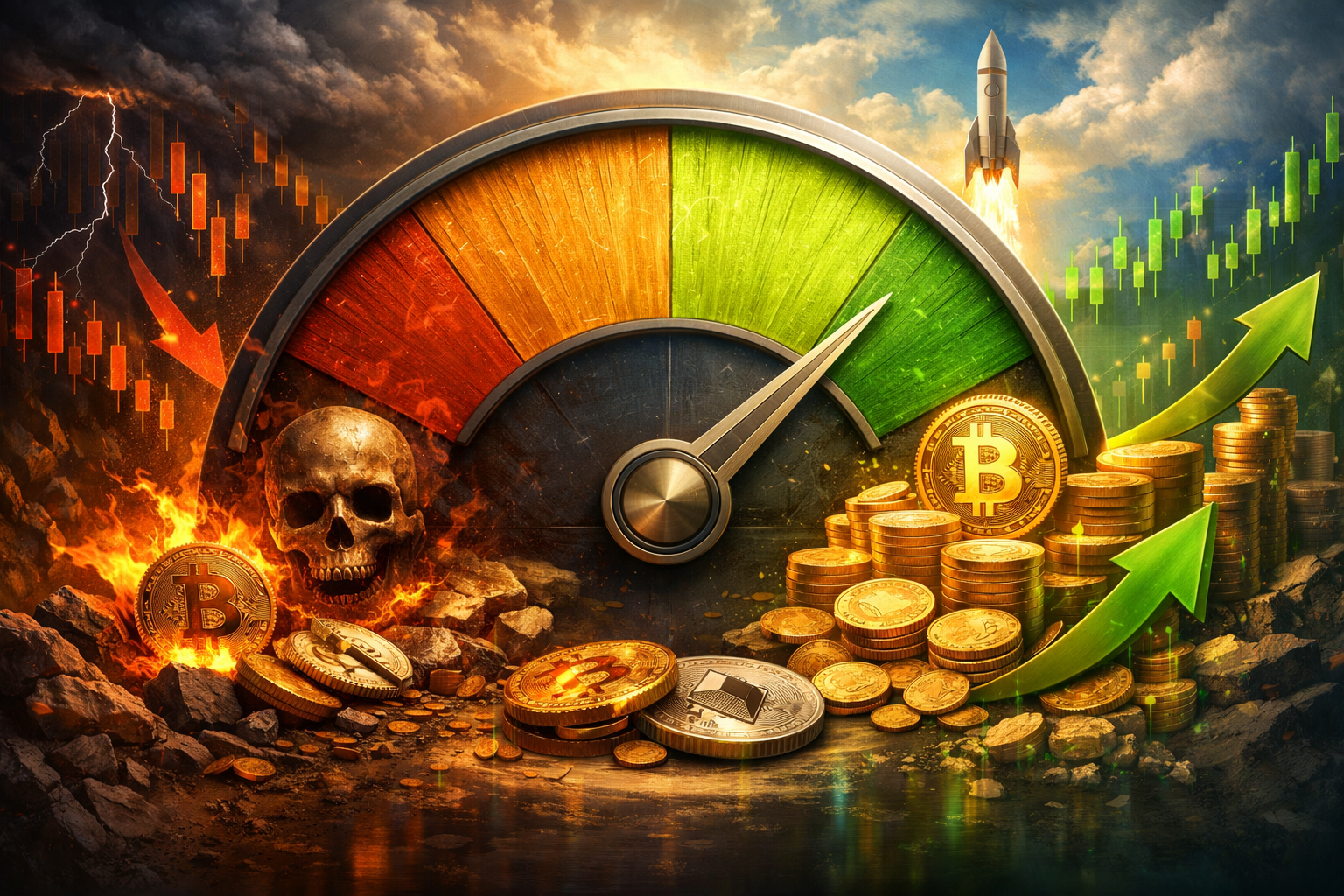

Ever notice how crypto crowds act like a herd? When prices pump, everyone’s screaming “to the moon” and piling in. When prices crash, the same folks panic and dump everything. It’s pure emotion. Fear and greed running the show.
Wouldn’t it be handy to have a single number that tells you exactly how scared or greedy the market is right now? Good news. You do. It’s called the crypto Fear and Greed Index. And smart investors use it to buy when others panic and stay calm when others go wild.
Today, let’s break down the crypto Fear and Greed Index in plain English. What it is, how it works, and how to actually use it in 2026 without getting burned. No fancy charts. No jargon. Just a simple tool to help you keep a cool head while everyone else loses theirs.
What Is the Crypto Fear and Greed Index?
Let’s keep it simple. The crypto Fear and Greed Index is a tool that measures the overall mood of the crypto market. It boils all that emotion down into one easy number from 0 to 100.
A low number means fear. A high number means greed. That’s the whole idea. When the score is low, folks are scared and selling. When it’s high, folks are greedy and buying like crazy.
The most popular version was created by Alternative.me back in 2018, inspired by CNN’s original Fear and Greed Index for stocks. It focuses mainly on Bitcoin and updates every single day, so you always get a fresh read on the market’s mood.
Why does this matter? Because crypto is driven by emotion more than almost any other market. And one famous investing rule says it best: be fearful when others are greedy, and greedy when others are fearful. The Fear and Greed Index is a quick way to spot exactly when the crowd is feeling each one.
Understanding the 0 to 100 Scale
The index runs from 0 to 100, split into a few simple zones. Here’s what each one means.
0 to 24 – Extreme Fear: The market is terrified. Lots of panic selling. Historically, these moments have often been good buying opportunities for patient investors.
25 to 49 – Fear: Folks are nervous and cautious. Prices may be dipping. The crowd is uneasy but not fully panicking.
50 – Neutral: The market is balanced. No strong fear, no strong greed. Things are calm and steady.
51 to 74 – Greed: Optimism is building. People are buying and getting excited. Momentum is picking up.
75 to 100 – Extreme Greed: Full FOMO mode. Everyone’s piling in, afraid to miss out. Historically, this is often when the market gets overheated and a pullback can follow.
Here’s the classic way smart investors read this. Extreme Fear can signal a potential buying chance, because everyone’s already scared and selling. Extreme Greed can signal caution, because the market may be running too hot. It’s the opposite of what your gut tells you. And that’s exactly the point.
How Is the Index Actually Calculated?
So how does one number capture the whole market’s mood? The index pulls together several data sources and weighs each one. Let’s break down the main ingredients.
Volatility (25%): Measures how wildly Bitcoin’s price is swinging compared to its recent average. Sudden big swings often signal fear.
Market Volume (25%): Looks at trading volume and momentum. Heavy buying during a strong run can flag greed and an overbought market.
Social Media (15%): Scans platforms like X for crypto hashtags and activity. A spike in hype and chatter can signal rising greed.
Surveys (15%): Polls that gauge how investors feel. This one is currently paused, but it was part of the original recipe.
Bitcoin Dominance (10%): Tracks Bitcoin’s share of the whole market. A rise often signals fear, as folks flee risky altcoins for the safer big coin.
Google Trends (10%): Watches search activity for crypto terms. Spikes in fearful searches can signal panic in the market.
All of these get blended together and compared to recent averages over the last 30 and 90 days. The result is that single 0 to 100 score you see each day. You don’t need to calculate any of this yourself. The tool does it all for you.
How to Actually Use the Fear and Greed Index in 2026
Now for the fun part. How do you actually put this thing to work? Here are the smart, practical ways to use it.
Use 1: Spot Potential Buying Zones. When the index drops into Extreme Fear, the crowd is panicking. That’s often when good coins go on sale. Patient investors watch for these moments to slowly buy in, not all at once.
Use 2: Get Cautious During Extreme Greed. When the index hits Extreme Greed, the market may be overheated. This is a good time to be careful, take some profits, or at least avoid chasing the hype with fresh money.
Use 3: Check Your Own Emotions. Feeling the urge to panic sell or FOMO buy? Glance at the index. If it confirms the crowd is doing the same, that’s a signal to slow down and think, not react.
Use 4: Combine It With Your Plan. The index works best alongside steady investing. It can help you tweak your timing, but it shouldn’t replace your overall strategy.
This pairs perfectly with a steady buying habit. If you want a calm, rules-based way to invest through any market mood, our dollar-cost averaging crypto guide shows you how to take emotion out of the equation entirely.
A Simple Real-World Example
Let’s make this concrete. Say the index drops to 15, deep in Extreme Fear. News is scary. Everyone’s dumping coins. Your gut says “get out before it gets worse.”
But a savvy investor sees that 15 and thinks differently. They know extreme fear has often marked good entry points in the past. So instead of panic selling, they calmly buy a small amount, knowing the crowd may be overreacting.
Now flip it. The index hits 90, deep in Extreme Greed. Your friends are bragging about gains. Everyone’s saying it’ll go up forever. Your gut says “buy more before you miss out.”
The savvy investor sees that 90 and gets cautious instead. They might take some profits or sit tight rather than chase the top. Same numbers, opposite reaction to the crowd. That’s how the index helps you act smart instead of emotional.
Knowing when to lock in those profits during greed is its own skill. If you want a clear framework for cashing out at the right time, our when to sell crypto guide walks you through it step by step.
The Limits: Don’t Treat It as a Crystal Ball
Here’s the honest truth. The Fear and Greed Index is useful, but it’s not magic. It can’t predict the future. Don’t bet your whole account on it.
A few things to keep in mind. The index mainly tracks Bitcoin, not the whole altcoin market. So it may not perfectly reflect what’s happening with smaller coins. Extreme Greed doesn’t guarantee a crash is coming, and Extreme Fear doesn’t guarantee a bottom. The market can stay fearful or greedy longer than you’d expect.
Big outside events, like major news or regulations, can shift sentiment in an instant. The index reacts to these, but it can’t see them coming. So treat it as one helpful signal among many, not the only thing you look at.
The smartest move is to use the index alongside other tools and a solid overall plan. It’s a thermometer for market mood, not a roadmap to riches. Use it to check the temperature, then make decisions with your full strategy in mind.
Pair Sentiment With Solid Risk Management
Here’s a key point most beginners miss. The index can tell you the market’s mood, but it can’t protect your money. That’s your job.
Even if the index screams Extreme Fear and looks like a great buying moment, you should never go all in. Size your buys carefully. Keep some cash on the side. Use stop losses if you trade. The index helps with timing, but smart sizing keeps you alive.
If you haven’t nailed down how much to bet and how to protect your downside, our crypto risk management guide covers position sizing and stop losses in plain English. Combine that with the index, and you’ve got a powerful, calm approach.
Common Fear and Greed Index Mistakes to Avoid
Here are the classic blunders. Don’t fall for these.
Mistake 1: Treating It as a Buy/Sell Signal. The index is a mood gauge, not a precise trading signal. Don’t blindly buy at every low score or sell at every high one.
Mistake 2: Going All In on Extreme Fear. Just because the crowd is scared doesn’t mean the bottom is in. Buy slowly and in small amounts, never your whole stack at once.
Mistake 3: Ignoring the Bigger Picture. The index only tracks sentiment. It can’t see major news, regulations, or your own goals. Always zoom out.
Mistake 4: Using It for Altcoins Blindly. The index is mainly about Bitcoin. Don’t assume it perfectly reflects what small altcoins are doing.
Mistake 5: Checking It Obsessively. Staring at the index all day fuels emotional decisions. Check it now and then, not every five minutes.
Fear and Greed Index Myths
Let’s bust some common myths about the crypto Fear and Greed Index.
Myth 1: “Extreme Fear always means buy.” Not quite. It’s often a good time to look for value, but the market can drop further. It’s a signal to pay attention, not an automatic green light.
Myth 2: “The index predicts the future.” Wrong. It measures current mood, not what comes next. It’s a thermometer, not a crystal ball.
Myth 3: “It works for every coin.” No. It’s built mainly around Bitcoin. Altcoins can behave very differently from what the index shows.
Myth 4: “A high score means a crash is guaranteed.” False. Extreme Greed signals caution, but the market can stay greedy and keep rising for a while.
Myth 5: “You only need this one tool.” Nope. It works best combined with a full strategy, risk management, and other indicators. It’s one piece of the puzzle.
Putting It All Together: Your Simple Sentiment Plan
Let’s wrap it into one easy plan you can use today.
- Check the index a few times a week, not obsessively.
- When it hits Extreme Fear, look for value but buy slowly and small.
- When it hits Extreme Greed, get cautious and consider taking some profits.
- Use it to check your own emotions before you act.
- Never treat it as a precise buy/sell signal on its own.
- Always pair it with risk management and a solid overall plan.
Speaking of the bigger plan, knowing how much of your money even belongs in crypto comes first. Our crypto vs stocks guide helps you decide your overall mix before you start timing the market with sentiment.
Wrapping It Up
So now you know exactly what the crypto Fear and Greed Index is and how to use it in 2026. It’s a simple 0 to 100 score that captures the market’s mood. Low means fear. High means greed.
The smart play is to lean against the crowd. Look for value when others panic in Extreme Fear. Get cautious when others go wild in Extreme Greed. But remember, it’s a mood gauge, not a magic predictor. Use it alongside risk management and a steady plan.
None of this guarantees profits. But it does help you keep a cool head while the rest of the market runs on raw emotion. And in crypto, staying calm and disciplined is a real edge.
You now understand the Fear and Greed Index better than most folks who glance at it without a clue. Use that edge. Stay calm. Stay smart. And let the crowd’s emotions work in your favor.
Frequently Asked Questions
What is the crypto Fear and Greed Index in simple words?
It’s a tool that measures the overall mood of the crypto market and turns it into one number from 0 to 100. A low score means investors are fearful and selling. A high score means they’re greedy and buying. It helps you spot when the crowd is panicking or getting overly excited.
How is the crypto Fear and Greed Index calculated?
It blends several data sources: volatility (25%), market volume (25%), social media activity (15%), surveys (15%, currently paused), Bitcoin dominance (10%), and Google Trends (10%). These are compared to recent 30 and 90 day averages and combined into one daily score from 0 to 100.
Should I buy when the index shows Extreme Fear?
Extreme Fear has often marked good buying opportunities in the past, but it’s not a guarantee. The market can keep falling. The smart approach is to look for value and buy slowly in small amounts, never your whole stack at once, and always pair it with proper risk management.
Does the Fear and Greed Index predict crypto prices?
No. The index measures the market’s current mood, not future prices. It’s a thermometer, not a crystal ball. Extreme Greed doesn’t guarantee a crash and Extreme Fear doesn’t guarantee a bottom. Use it as one signal among many, alongside a full strategy.
Does the index work for altcoins too?
Not perfectly. The most popular version from Alternative.me is built mainly around Bitcoin, since a big part of it is Bitcoin’s price volatility. Altcoins can behave very differently, so don’t assume the index reflects what smaller coins are doing at any given moment.
Disclaimer
The content of this article is for informational purposes only. It is not financial, investment, or legal advice. Cryptocurrency prices are volatile and carry risk. Always do your own research and talk to a qualified expert before you make any investment choices. vCryptoCoin does not take responsibility for any losses that may occur from acting on the information in this article.